Responsible innovation
In keratopigmentation, as in any medical discipline undergoing development, the challenge is not only to innovate, but to define the conditions under which an evolution can be considered reliable, reproducible and transferable. Fifteen years of clinical experience, scientific publications and regulatory structuring now make it possible to establish these foundations with precision.
Keratopigmentation, sometimes referred to as corneal tattooing, is not a recent technique. Ali ibn Isa described a form of it as early as the 10th century to conceal leukomas. From the 19th to the 20th century, surgeons used insoluble pigments to camouflage corneal opacities following trauma. At the time, the technique remained artisanal, poorly reproducible and highly dependent on the practitioner. It was the arrival of the femtosecond laser in the 2000s, followed by the pioneering work of Prof. Alió from 2009 onwards, that laid the foundations for a structured practice: defined medical indications, surgical protocols, safety criteria and outcome analysis.
It was in this context that BIOTIC Phocea developed BIOCHROMAEYES® in the early 2010s, transforming a still-experimental technique into a high-precision corneal device, with Class IIb CE marking, annual audits by a notified body and publications in peer-reviewed scientific journals. Fifteen years of work.
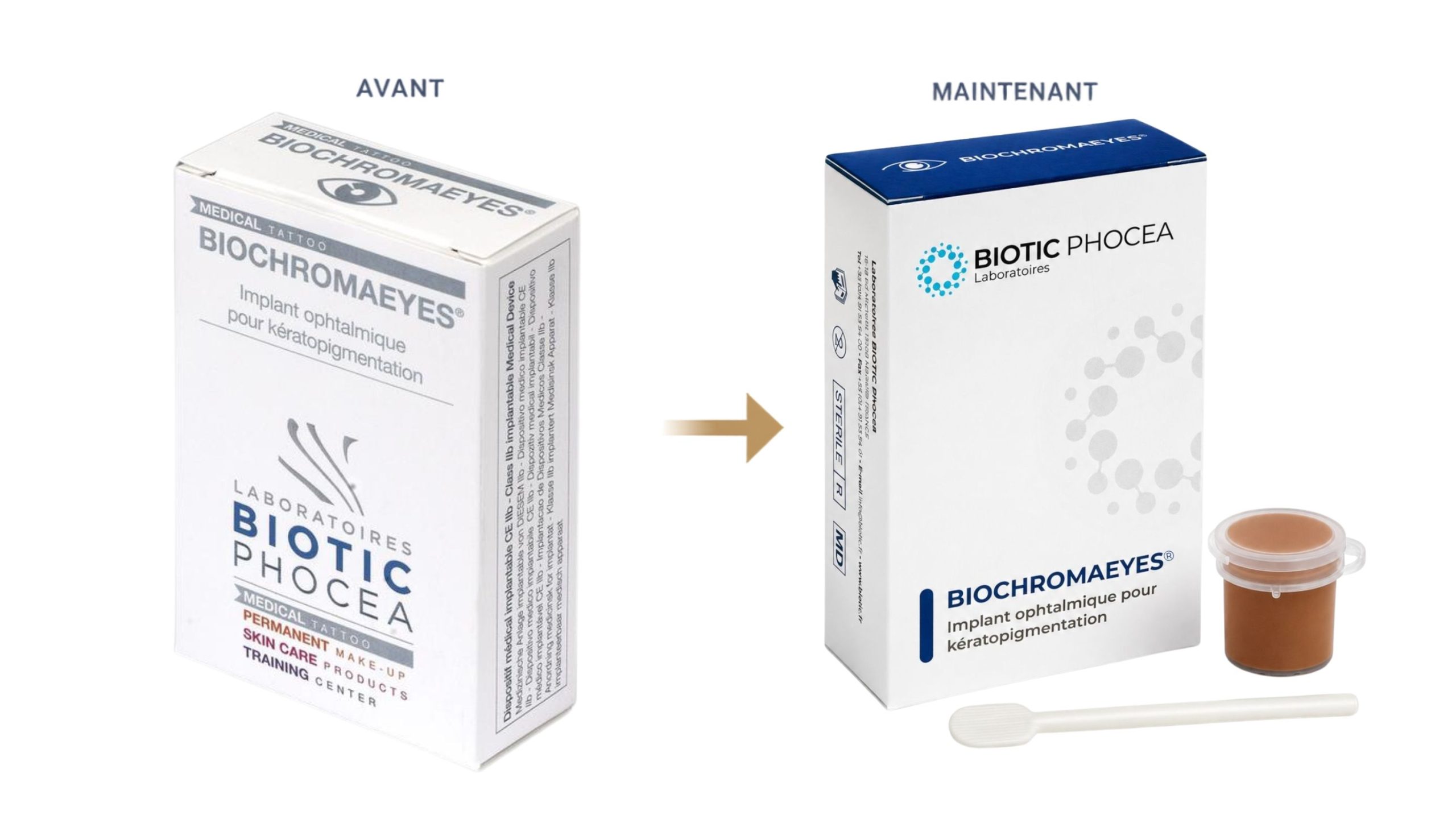
Evolution of BIOCHROMAEYES® Medical Device packaging
Evaluate before implementing
Even a minor technical evolution involves several parameters simultaneously: the biological tolerance of corneal tissues, the long-term stability of keratopigmentation pigments, and the visual result under different lighting conditions. Modifying one of these parameters without assessing its interactions with the others introduces variables that short-term clinical results may not always reveal.
Medical disciplines have long incorporated this principle into their standards. ISO 14971 structures risk analysis around a precise logic: identify what could go wrong, assess the probability and severity, and then determine whether the benefit justifies the residual risk. This framework requires a step-by-step approach, without skipping observation phases.
A protocol should be adopted when its results remain stable at six months and one year, across different patient profiles and in the hands of different practitioners. It is precisely this more than fifteen years of clinical experience, documented in major scientific publications such as the British Journal of Ophthalmology, that underpins the credibility of BIOCHROMAEYES®.
Reproducibility as a criterion of maturity
A technique that performs brilliantly in the hands of its creator has limited value if it cannot be successfully transferred to others. Reproducibility requires formalized protocols, structured training and the ability to document deviations in order to understand their causes. Without this, each practitioner works in isolation, without benefiting from collective experience.
This is where the regulatory framework plays a structuring role. The European Medical Device Regulation (EU) 2017/745 imposes traceability and documentation requirements that help build this shared knowledge base. As a Class IIb implantable corneal medical device, BIOCHROMAEYES® is audited annually by EUROFINS, an independent accredited notified body. Compliance with these requirements contributes to the collective reliability of the sector, for the benefit of practitioners and their patients.
Continuous improvement
The most robust advances in medicine tend to resemble a series of progressive adjustments rather than sudden revolutions: a refined formulation, a slightly modified application technique, or a better-calibrated follow-up protocol. This incremental approach makes it possible to test changes under controlled conditions, measure their actual effects and make corrections if outcomes differ from expectations.
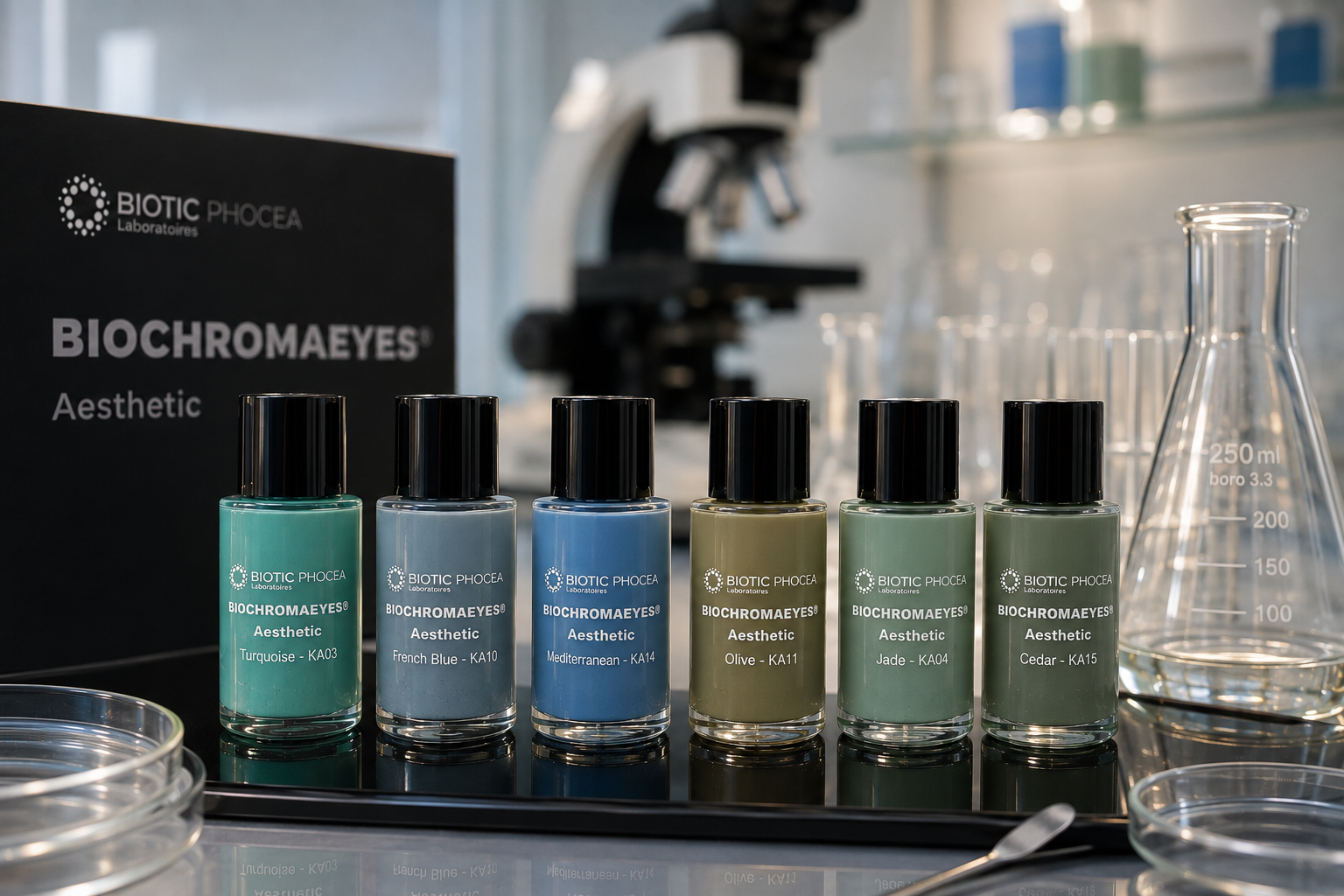
It was in this spirit that BIOTIC Phocea announced at the KOLOR CONGRESS World Keratopigmentation Congress in Dubai the filing of two European and US patents for BIOCHROMAEYES® Aesthetic, the result of more than two years of research:
1
A black pigment based on activated carbon, free from iron oxides and nanoparticles: a world first that confirms the absence of MRI-related risk and ensures exceptional long-term stability.
2
A white pigment formulated without titanium dioxide and based on boron nitride, for enhanced color stability.
These two innovations are part of a forward-looking approach: improving stability, enhancing safety in use and anticipating future regulatory developments. In keratopigmentation, the stability of a result is assessed at six months, one year and sometimes beyond. This is why the constant objective remains to improve what already exists with the necessary perspective, rather than replacing it prematurely.


Photo credit: www.flaak-newcolor.art
What this requires of the practitioner
Beyond protocols and standards, the rigorous integration of innovations in keratopigmentation also depends on the practitioner’s own approach. Mastering a technique requires an understanding of the mechanisms that underpin it in order to assess its limitations, identify warning signs and distinguish genuine progress from an insufficiently documented trend.
This ability to exercise sound judgement develops with experience, but it is also cultivated through active monitoring and dialogue with other stakeholders in the field. This is one of the reasons why BIOTIC Phocea is building a community of practitioners around BIOCHROMAEYES®, with training, dedicated technical support and events such as the Kolor Congress, where ophthalmic surgeons and researchers exchange knowledge around a shared objective: advancing the practice safely.
Conclusion
In keratopigmentation, the maturity of a technique is measured by its ability to produce stable, natural, documented and reproducible long-term results. This is what the scientific literature has demonstrated over the past fifteen years, and why innovation is inseparable from methodology.
Frequently Asked Questions
What is keratopigmentation, or corneal tattooing?
Keratopigmentation is an ophthalmic technique that involves introducing biocompatible pigments into the cornea, either to correct abnormalities of medical origin or to change the color of the eye while preserving the iris. It is performed exclusively by ophthalmic surgeons, using a femtosecond laser that enables precise and reproducible implantation while preserving the integrity of the cornea and the patient’s visual acuity.
What standards apply to keratopigmentation pigments?
In Europe, pigments used for reconstructive keratopigmentation fall under the Medical Device Regulation (EU) 2017/745. Class IIb products such as BIOCHROMAEYES® are subject to assessment by an independent notified body, batch traceability and biocompatibility testing in accordance with ISO 10993. This framework requires continuous documentation and regular audits.
Why is long-term clinical experience essential in keratopigmentation?
The cornea is living tissue, and its interactions with an implantable pigment must be observed over the long term. A satisfactory short-term result does not guarantee long-term performance or biological tolerance. This is why scientific publications based on case series with extended follow-up provide the most reliable basis for evaluating a technique, a pigment and its tolerance.